

Bits #60
Culture download culture download dulture cownload

Happy Sunday! Yesterday I read that we have 50,000 thoughts a day and now my brain feels like a motorway.
Under the paywall today: the tyranny of the ‘hot mom’; the limitations of mental health discourse; the precarious pedestal of ‘the authentic woman’; why fashion is already full of Lauren Sanchez’s; more Heated Rivalry chat (can’t stop won’t stop); and 3 great things I bought this week.
The best thing I watched this week was A Friend of Dorothy, a sweet and tender short film by Lee Knight which has been nominated for an Oscar. It’s about the friendship between a wealthy, widowed patron of the arts, Dorothy (Miriam Margolyes) and 17-year-old JJ (Alistair Nwachukwu) which begins with a serendipitous meet-cute, when JJ kicks his football into Dorothy's garden. He needs a mentor - someone to believe in him, really - she needs some help at home, but what both of them need the most is a friend.
‘Friend of Dorothy’ is an old code word for a gay man - stemming from the 1939 film Wizard of Oz, feat. gay icon Judy Garland - and that is what Dorothy is to JJ: a wise friend who sees him better than he sees himself, encouraging him to follow his passion for acting and embrace his sexuality. Fucking hell, she breathes (pure Margoyles), a tear running down her face, when he performs for her for the first time. They are both exceptional, and it’s 22 minutes of pure heaven.
And the best thing I read this week was Georgie’s F**king 40th, a letter by Tina Brown about her son, Georgie, who has Asperger’s syndrome and just celebrated his 40th birthday in dazzling style. Tina’s a news and politics hound and doesn’t do much personal writing, but god, I hope she does more - it is written with her characteristic wit and verve, but it’s also immensely moving while being unsentimental (the winning combo).
“Every night for a year and a half in 1998, Georgie made us watch the scene in Titanic when Rose stands on the bridge of the ship and threatens to throw herself off. On a Disney cruise, he climbed out onto the tip of the prow and tried to re-enact the scene, warbling My Heart Will Go On with arms akimbo, until an officer insisted he was confined below deck.
Parentally challenging? Yes. But Georgie is also blessed with uniquely wonderful qualities that cancel out the rest: his perennially upbeat energy, his guileless social brio, his disinhibited displays of affection, his unfiltered inability to say anything untrue or be anything but himself. It was all over image-wise this past new year at a White Lotus-like hotel in the Dominican Republic, when the chic, sarong-clad French concierge proffered us an exotic-looking welcome drink. Georgie’s response: “I didn’t pack enough underpants.”
My favourite bit is when Tina receives a 3am text from her daughter, Izzy, Georgie’s official party organiser, navigating a guest list that includes “last night’s Uber driver, Yevgeny, who was really hot”, who says that if she has to talk about the cheese plate one more time she is going to cease life. Read, and feel lit up from within.
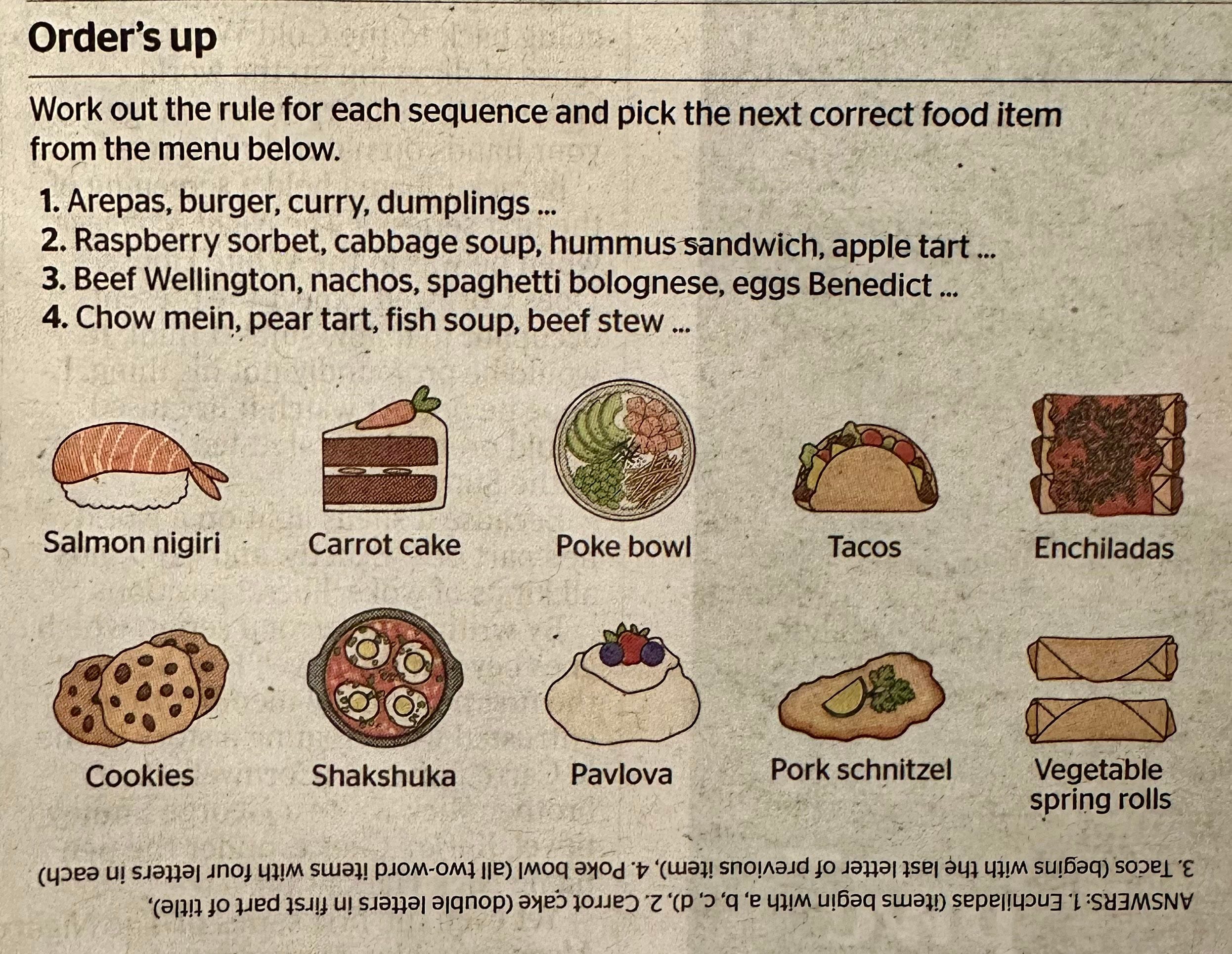
Apparently Mensa is on the skids and so The Times ran a quiz to see if any brainiacs out there can help. I could not solve a single one, although now I know the answers they are of course abundantly obvious - can you?
This piece about dumbphones in WIRED caught my eye and not just because the title made me laugh. In Dumbphone Owners Have Lost Their Mind, journalist Elana Klein explores the limitation of dumbphones (it’s almost impossible to get through a whole day without needing an app, and have you tried to do a full week without maps?) and offers a fresh (terrifying) perspective on why ‘un-meshing’ from our iPhones would leave us significantly less functioning. What has been lost, she says, cannot be recovered.
“[T]he transition from lifelong smartphone user to sudden dumbphone user would result in a profound blow to my mind’s operating system. If I get a dumbphone, I’ll have to face the rudimentary version of myself. And although the true capabilities of my bare-bones brain are a mystery to me, I do know that the change would be a downgrade”.
If reading that gave you the willies, wait until you read about how we are all going to become “mild cyborgs of some kind” :)
Linguistic creep is one of my most anal pet peeves - make neologisms tight again! - so this sassy piece by Hillary Busis for Vanity Fair on the drift of ‘nepo baby’ tickled me. Having rich parents is not the same as nepotism, she writes:
“In fact, despite what critics in the 20-teens would have had you think, arguably none of the girls on Girls were true-blue nepo babies. Allison Williams didn’t go into newscasting. Zosia Mamet acts in plays but doesn’t write them. Jemima Kirke’s parents are a drummer and a boutique owner. Yes, she’s a childhood friend of Dunham’s, but if you get a job because of who you’re friends with rather than who your parents are, that isn’t nepotism either—it’s cronyism. Words have meaning! We live in a society!”
I had the pleasure of working with Stevie Martin in my twenties and she is not only an excellent comic actor but one of the funniest writers I know, with that Michael McIntyre-ish ability to make household items funny, but with a delightfully weird bent and an endless capacity for mining her own personal chaos. Her latest letter on mornings has one of my favourite opening paragraphs of 2026 (so what if it’s only February 1st):
“If you look up ‘Not A Morning Person’ in the dictionary, and if the dictionary included phrases rather than single words, and if dictionaries still existed as physical books you could look things up in, there would be a picture of me (if the dictionary involved pictures).”
It’s always amused me that Hulu’s Mormon housewives don’t sully themselves with caffeine and alcohol but have lashings of botox and fillers, but I’d never considered the conflict re: MAHA. This is a witty (“just look at the ‘Mar-a-Lago faces’ in RFK Jr.’s orbit”) and well-researched piece by Daisy Schofield for The Cut about how anti-vaxxers justify Botox. This is a particularly interesting observation:
“Humans are not great at dealing with the concept of risk, and for whatever reason, vaccines have become politicized in a way that Botox or other medications haven’t, and that introduces fear and uncertainty,” Hayley Goldbach, an assistant professor of dermatology at Brown University, tells me. “I wonder if people feel more comfortable because it’s easier to ‘see’ the effects from Botox whereas vaccines somehow feel more abstract — especially if you don’t understand the science and biology.”
It got me thinking about how in our hypervisual world, we most readily accept that which is conscpious - and how terrifying that is in the context of (mostly invisible) health care.